
A bluetooth adapter for boat use is the same job as in a car: give the stereo a wireless source through its aux input, over its FM band, or by swapping in a marine head unit, and power it from the boat's 12-volt system. The adapter side does not change; the boat adds two disciplines. The 12-volt system is the only power aboard, so an adapter left switched on is a slow drain, and the marine air corrodes ordinary wiring, which is why permanent installs use tinned copper.
Paths on this page were checked October 2026. A bluetooth adapter for boat stereos solves the same problem it solves in a car: the boat has a perfectly good stereo, and no way to play the phone through it. The fix is the same, too, because a boat stereo runs on the same 12-volt electricity as a car unit. Feed the stereo a wireless source through its aux input, over its FM band, or by swapping in a marine head unit. What the boat changes is everything around the adapter. The 12-volt system is also the only power on board, so an adapter left switched on is a drain nothing repays, and the marine air corrodes connections that would last for years in a garage.
First, what the boat stereo already has
Start the way the car version of this job starts: by checking whether the boat needs anything at all. Plenty of current units pair a phone outright; Kenwood's marine range, for one, is built around receivers that stream over the A2DP profile every phone carries, the same profile a car stereo negotiates. Look for a Bluetooth or source menu on the unit, check the manual, and only buy an adapter for the inputs the boat actually lacks: a 3.5 mm aux jack on the faceplate, a rear RCA aux pair, or neither.
The model number does the talking here. It is printed on the faceplate bezel or the owner's card, and it settles three questions in one lookup: whether a Bluetooth menu exists, which inputs sit on the rear panel, and whether the unit is a plain AM/FM box from an era when none of this was standard. Older simplex stereos are exactly the audience for the three paths below, and knowing which inputs exist before ordering keeps the adapter choice from being a guess.
Path one: the aux-in bluetooth adapter
The gentlest path needs two things from the boat: an audio input on the stereo and a power feed. A receiver with a matching output plugs into the jack or the RCA pair, and the stereo treats the arrangement as the auxiliary source it is. The two common inputs, the 3.5 mm faceplate jack and the rear RCA pair, are both consumer line-level inputs, so the only matching that matters is the plug: an RCA-output receiver feeds the rear RCA aux inputs directly, a plain 3.5 mm cable bridges a headphone-style output to an aux jack, and professional XLR outputs belong on larger installations rather than a cockpit stereo.
- What it needs: an aux or RCA input, and 12-volt or USB power within cable reach.
- What changes: nothing permanent; the jack was already there.
- What it carries: stereo audio over A2DP, paired from any phone at the dock.
Placement is the whole installation, and it is easier here than in a car: the cockpit is open air rather than a steel cabin. Keep the receiver out of the spray line, off surfaces that go wet, and close to the stereo's input side, and the link behaves.
Powering a bluetooth adapter for boat use
Power is where boats part company with cars. A 12-volt socket or a USB port works exactly as it would in a vehicle, but on many boats those sockets stay live whenever the battery switch is on, docked or not, so an adapter that stays paired keeps drawing a small current with no engine running to repay it. Over a week tied to the dock, that trickle adds up.
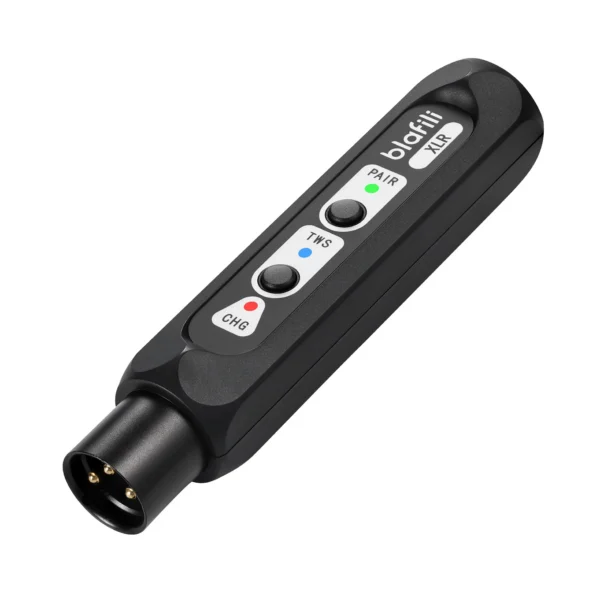
The habits are simple. Unplug the adapter when the season ends. Feed it from a switched socket where the boat has one. Or take the boat's wiring out of the equation: a receiver that runs on its own battery charges off the boat and carries its power with it. blafili's XLR receiver, for one, takes USB power and carries a 16-hour battery, which covers a stretch of evenings without asking anything from the house bank. Charged before the trip, it plays through a day of cruising and a dockside dinner, and the boat's batteries are none the wiser.
Path two: the FM transmitter
The zero-install path carries over unchanged. The transmitter plugs into the 12-volt socket, the phone pairs it, and the boat radio tunes in the low-power FM broadcast, giving the stereo a wireless source with nothing plugged into its audio side at all. The bargain is the same as in a car: on open water a clear frequency is usually easier to find than in a dense city, but a long run down the coast crosses other broadcasters, so expect to re-tune. The car guide carries the full method for sweeping the band and living with the route.
Path three: a marine head unit with Bluetooth built in
The full path replaces the stereo, and marine head units carry Bluetooth, USB, aux and AM/FM in one DIN chassis built for the environment. The spec sheets read like car units because the electrics are car units: Kenwood prints "Operating voltage 12V DC car battery" on the KMR-M332BT, alongside its A2DP and AVRCP profile lines and a Bluetooth radio rated at approximately 10 m (32.8 ft) line of sight. Two details on that page are worth noticing, because they are the marine differences in miniature. The circuit boards carry a conformal coating, which the spec sheet describes as "improved moisture resistance of the circuit boards to prevent corrosion". And up to five phones can pair at once, so swimmers and raft-up neighbors take turns streaming without re-pairing.
Control grows along with the swap. The same Kenwood unit is listed as ready for an optional wired remote control, and its maker's phone app can control most basic functions of the receiver over the paired Bluetooth connection, which means volume and source move to whoever holds the phone. Neither detail belongs to the adapter path; both are the kind of thing a new head unit brings with it.
- What it needs: a DIN cutout, a wiring adapter, and an afternoon.
- What changes: the whole stereo, including its Bluetooth.
- What it gains: every source in one chassis, and hardware built for spray.
A swap also retires the adapter question entirely: the new unit brings its own aux and USB, so nothing needs plugging into anything.
Wiring and moisture: what the marine environment changes
A plug-in adapter needs no wiring. Permanent 12-volt work on a boat is a different material conversation, and it is the one place the environment changes the parts list. Ordinary cable cores corrode fast in marine air; marine-grade wire uses tinned copper strands for exactly that reason. Ancor, a long-running marine wire brand, describes its tinned copper products by the standards they are designed to meet, UL, ABYC, NMMA and USCG among them, and the American Boat & Yacht Council maintains the standards program behind those letters. Our speaker wire reference covers the tin-plating logic in detail for anyone running new cable out to deck speakers.
For the adapter itself, moisture means placement rather than wiring: a dry spot under the dash or inside the cabin, above the spray line and clear of the wet locker, is all the protection a consumer gadget asks for.
The other wireless direction: a transmitter and portable speakers
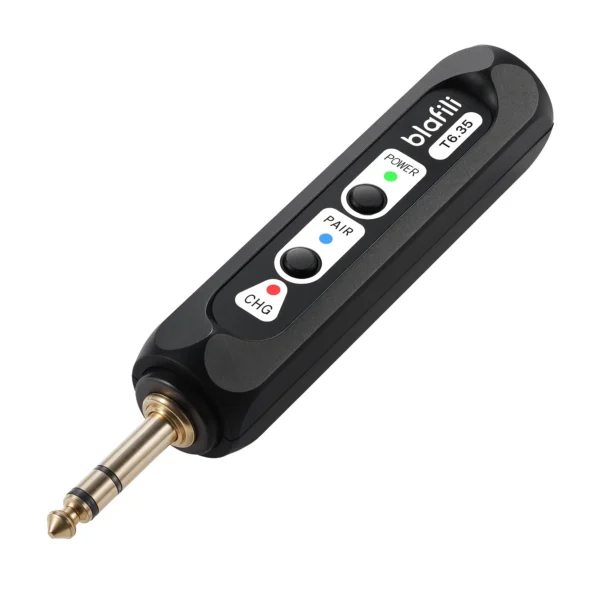
One more arrangement suits boats where the stereo is fixed but the listeners move: send the music out instead of in. A Bluetooth transmitter takes the stereo's line or record output and streams it to portable speakers out on deck or down on the dock. blafili's T6.35 transmitter, for one, takes a 1/4-inch TRS or RCA input and transmits to two receivers at once, which splits sound between cockpit and dock without running cable across a transom. It is also the tidy answer for a borrowed boat: nothing mounts, nothing wires in, and the owner's stereo stays untouched.
Choosing the boat path
| Path | Needs from the boat | Effort | Keeps the factory stereo |
|---|---|---|---|
| Built-in Bluetooth | Already there | None | Yes |
| Aux-in adapter | Aux or RCA input + power | Plug in | Yes |
| FM transmitter | 12 V socket + FM radio | Plug in and tune | Yes |
| Marine head unit swap | DIN space + wiring | A real job | No |
The two plug-in rows carry the same limit they carry in a car: the boat's own electronics stay as they are, so a stereo with no input at all pushes the choice to FM or a swap. Whatever the path, two habits hold on the water. Put the adapter where the spray is not, and unplug it when the season ends.
FAQ
Only if it stays powered. A receiver draws a small current whenever it is on, and on many boats the 12-volt socket stays live at the dock, so a week of sitting can add up. Unplug the adapter for the season, feed it from a switched socket, or pick a battery-powered receiver that charges off the boat.
Electrically, yes: both run on 12-volt DC, and an adapter does not care where the volts come from. The difference is the environment. Keep the adapter out of the spray line and off surfaces that go wet, and for permanent wiring use marine-grade tinned copper rather than ordinary household cable.
Two of the three paths need no input jack at all. An FM transmitter broadcasts to the boat radio the way it does in a car, and a marine head unit swap brings its own Bluetooth, USB and aux. Some stereos also take a source on rear RCA inputs, which an RCA-output receiver can feed directly.
Open air helps it: there is less between the phone and the adapter than inside a house. The obstructions that matter are the boat itself, a cabin wall or a console, and the modest radios in many head units, which print line-of-sight ranges around 10 meters. Place the adapter in the open near the stereo and keep the phone in the cockpit rather than below deck.
blafili XLR Bluetooth Receiver
A Bluetooth receiver with an XLR output, aptX HD and a 16-hour battery that takes its power over USB, for audio spots beyond the reach of mains power. Pair a phone, feed the stereo, and let the battery cover the evenings the boat sits unpowered.
- Kenwood KMR-M332BT marine receiver spec page: "Operating voltage 12V DC car battery"; "Improved moisture resistance of the circuit boards to prevent corrosion" (conformal coating); "Up to 5 Bluetooth® devices can be paired to the receiver at the same time"; A2DP/AVRCP profile lines; "Maximum Communication range Line of sight approx.10m(32.8ft)". kenwood.com/usa/car/motorsports/kmr-m332bt/, accessed 2026-10-13
- Kenwood USA marine category page: the KMR-M332BT listed among the marine receivers. kenwood.com/usa/car/marine/, accessed 2026-10-13
- Ancor brand page (Navico): "For over 40 years, Ancor has been the industry leader for high-quality tinned copper Marine Grade® wire and cable" and "Ancor products are manufactured to precise specifications and designed to meet UL, ABYC, NMMA, and USCG standards." navico.com/ancor, accessed 2026-10-13
- ABYC standards page: the American Boat & Yacht Council maintains a standards program and a standards library for boatbuilding. abycinc.org/standards, accessed 2026-10-13
- Bluetooth SIG, Advanced Audio Distribution Profile 1.3.2: the streaming profile a phone and a stereo adapter negotiate. bluetooth.com/specifications/specs/advanced-audio-distribution-profile-1-3-2/, accessed 2026-10-13
- blafili published product specifications (XLR receiver: XLR output, aptX HD, USB power, 16-hour battery; R1: RCA output; T6.35: 1/4-inch TRS + RCA input, simultaneous transmission to two receivers), per lab PROFILE caliber table, accessed 2026-10-13